Beam Me Into Your Tribe: How Sci-Fi Cons Became the Unexpected Antidote to American Loneliness
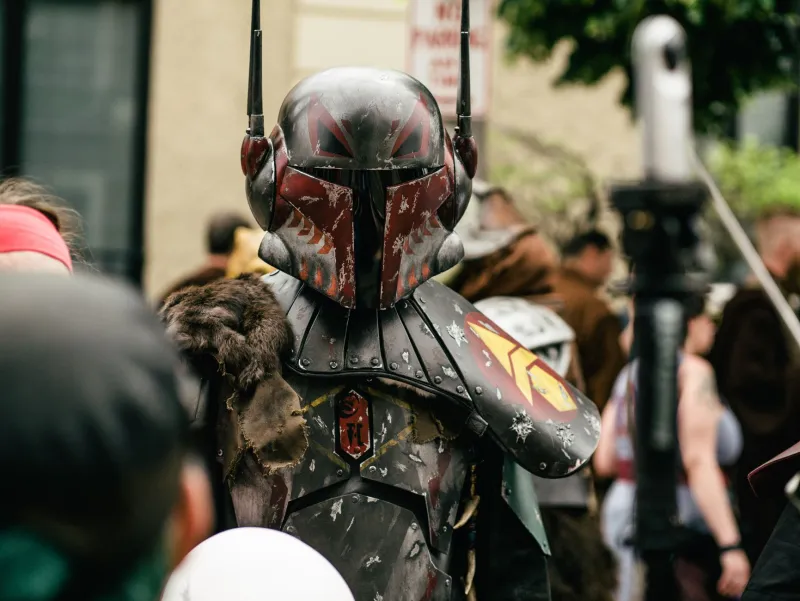
Walk into any mid-sized convention center on a Saturday morning in almost any American city, and you'll witness something that looks, on the surface, like pure spectacle. There's a woman in a hand-stitched Nebula costume talking intensely with a guy in a foam Mandalorian helmet. A cluster of teenagers comparing their hand-painted lightsaber hilts. A retired schoolteacher from Ohio explaining her Stargate cosplay to a wide-eyed eight-year-old. It's chaotic, loud, and kind of overwhelming.
It's also, according to a growing body of psychological research and the lived experience of hundreds of thousands of attendees, one of the most socially healing environments in modern America.
That's not a sentence you expect to write. But here we are.
The Loneliness Numbers Are Brutal
Before we talk about the solution, it helps to understand the scale of the problem. The U.S. Surgeon General declared loneliness a public health epidemic in 2023, with data showing that nearly half of American adults report measurable feelings of isolation. Social disconnection has been linked to outcomes as serious as heart disease, cognitive decline, and shortened lifespan. We're a country that is, in many measurable ways, coming apart at the seams socially — even as we've never been more digitally "connected."
The conventional fixes — therapy, community groups, religious institutions, neighborhood associations — are all struggling to reach people, especially younger adults who've grown up with screens as their primary social interface. So where are isolated people actually finding community?
Increasingly, the answer involves someone in a full Xenomorph suit.
Permission to Be Weird, Granted
Marcos T., a 34-year-old software developer from Austin, describes himself as someone who spent most of his twenties feeling fundamentally out of place. "I'm not great at small talk. I don't follow sports. I don't do bars," he says. "Normal social situations feel like I'm performing a role I never auditioned for."
His first sci-fi convention changed that calculus completely.
"The first time I walked into a con, I realized everyone there had opted in to something specific," he explains. "You already have a shared language. You don't have to explain why you care about something. The conversation just starts at a completely different level."
This is what psychologists call a "context of shared meaning," and it turns out to be enormously powerful. Dr. Priya Anand, a social psychologist who studies community formation, describes conventions as "pre-filtered social environments" where the barrier to meaningful connection drops dramatically. "When you already know someone cares deeply about the same fictional universe you do, you've skipped about six months of the usual social vetting process," she says. "You're immediately operating with a baseline of trust and mutual recognition."
Cosplay as Social Technology
One of the more counterintuitive elements of the convention healing effect is cosplay itself. Dressing as a fictional character might seem like escapism — and it is, partly — but it also functions as a surprisingly sophisticated social tool.
For people who struggle with social anxiety, cosplay offers what researchers call a "role scaffold." When you're dressed as Captain Picard or a Sith Lord, you have a character to inhabit, a ready-made identity that can serve as a kind of social training wheels. The costume becomes a conversation starter that removes the terrifying pressure of having to just be yourself in a room full of strangers.
Jamie L., a 27-year-old from Portland who was diagnosed with social anxiety disorder at 19, describes the transformation vividly. "The first time I wore a full cosplay, I felt like I was behind glass. Protected. And then people kept coming up to me wanting photos, wanting to talk about the character. By the end of the day, I'd had more genuine conversations than I'd had in the previous six months combined."
Over several conventions, that scaffolding gradually became unnecessary. "I started making friends as Jamie, not as the character. But the costume was the door I walked through to get there."
Convention Organizers Are Paying Attention
The people running these events have started to consciously lean into this social function. Sarah Chen, who organizes a mid-Atlantic regional sci-fi convention that draws around 8,000 attendees annually, says the programming has shifted noticeably over the past decade.
"We still have celebrity panels and dealer halls, but we've added a lot more programming specifically designed to help people connect," she says. "Meetups for people with anxiety, first-timer orientation sessions, panels on mental health in fandom. It's become a real part of what we do."
Some larger conventions have introduced quiet rooms — low-stimulation spaces where overwhelmed attendees can decompress — along with explicit anti-harassment policies that create a clearer sense of safety than many general social environments offer. "We want people to know that this is a space where they can actually relax," Chen explains. "That's not a small thing for a lot of our attendees."
The Space Between the Stars
There's something poetic about the fact that communities built around imagining humanity's future in the cosmos have become a refuge for people struggling in the present. Science fiction, at its core, is about possibility — the idea that things can be different, that the universe is larger and stranger and more full of wonder than daily life suggests. That ethos carries over into the convention floor in ways that are hard to quantify but easy to feel.
For many attendees, particularly those who felt like outsiders growing up — too nerdy, too weird, too intense about the things they loved — conventions represent proof of concept. Proof that there are other people who care about the same things. Proof that the version of yourself you kept hidden is actually the version other people want to meet.
"I spent years thinking I was broken because I'd rather talk about theoretical faster-than-light travel than whatever was trending on social media," says Marcos. "Walking into a con the first time and realizing there were thousands of people who felt the same way — that was genuinely life-changing. Not an exaggeration."
Not a Perfect Solution, But a Real One
It's worth being clear-eyed here. Conventions aren't therapy, and they can't replace professional mental health support for people dealing with serious issues. They can also be expensive, exhausting, and occasionally overwhelming — the sensory environment alone can be a significant barrier for some people.
But as one piece of a larger social ecosystem, they're doing something real. In a cultural moment when Americans are increasingly struggling to form the kinds of genuine, sustained human connections that we know are essential to wellbeing, these gatherings of people in foam armor and alien makeup are quietly, stubbornly building something valuable.
The final frontier, it turns out, isn't just out there in the dark between the stars. Sometimes it's a convention center in Cincinnati, and the aliens you're meeting are your people.
And you've been waiting your whole life to find them.